Securing Cursor, Codex, and Claude Code: A Comparison of AI Coding Agent Risks
The AI coding agent market has fragmented fast. Cursor, Codex, and Claude Code each take a different architectural approach to interacting with your code, file system, and infrastructure. The same security policy applied to all three will either over-restrict the safer surfaces or under-protect the riskier ones.
Architectural Overview
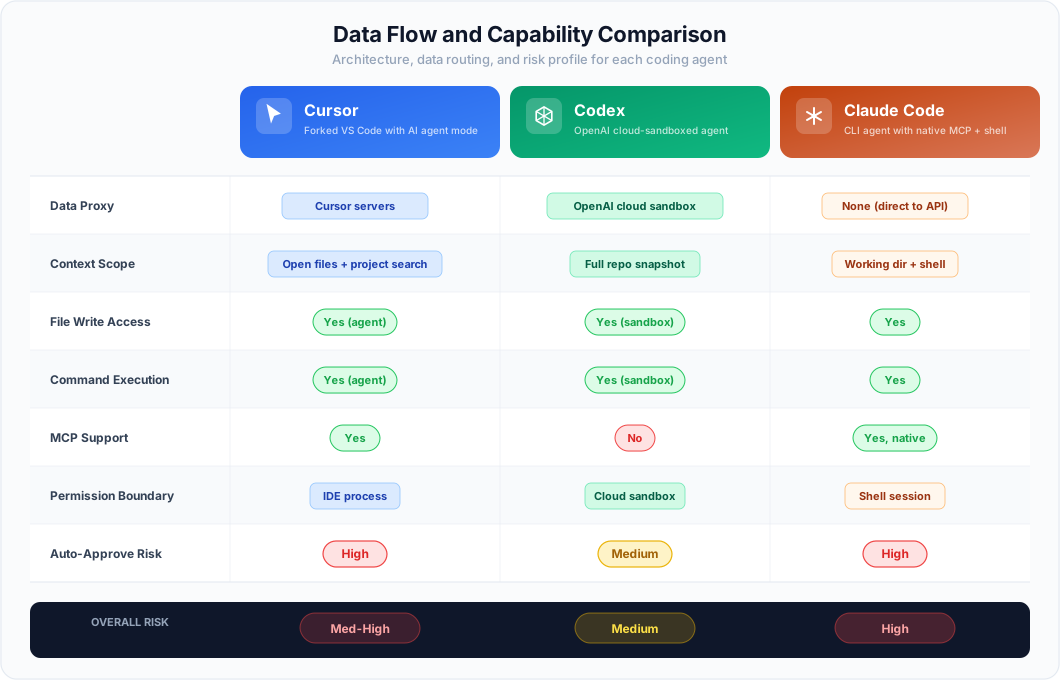
Cursor is a forked VS Code with integrated AI. It supports multiple model backends through Cursor's own API proxy. Agent mode (Composer) can read and write files, execute commands, and search across projects. Data flows through Cursor's servers before reaching the model provider, which means two third parties handle the data, not one.
Codex (OpenAI) is a cloud-sandboxed coding agent. Unlike IDE-embedded tools, Codex executes tasks in an isolated cloud environment with a snapshot of your repository. It can read files, write code, and run commands inside the sandbox. Data flows through OpenAI's infrastructure, and the sandbox boundary limits direct access to local developer machines, but the repository contents and prompts are transmitted to OpenAI's API.
Claude Code is a CLI tool. It runs in the terminal and inherits shell permissions, not an IDE sandbox. It has native MCP support and communicates directly with Anthropic's API with no intermediary.
Data Flow Comparison
Risk Profiles
Cursor: Medium-High. Two-hop trust chain (Cursor proxy plus model provider). Broad agent mode capabilities. Multi-model support complicates per-provider policy. Cursor RCE vulnerabilities documented in 2025 demonstrated how prompt injection through repository content can hijack agent behavior.
Codex: Medium. The cloud sandbox limits blast radius for destructive actions since commands execute in an isolated environment rather than on the developer's machine. However, the full repository snapshot means all code, config files, and potentially secrets checked into the repo are transmitted to OpenAI. Codex cannot access local MCP servers or the developer's file system directly, but it can propose code changes that are merged back, creating a supply-chain trust decision at the PR review step.
Claude Code: High (highest capability, highest surface). Full shell permissions. Native MCP. No IDE sandbox. The most powerful agent and the largest attack surface. Direct API connection means no third-party proxy where controls can be added at the vendor layer.
Why Per-Tool Governance Does Not Scale
The first instinct is to write Cursor-specific controls, Codex-specific controls, and Claude Code-specific controls. That fails for three reasons.
Developers switch tools. A developer who used Cursor last quarter is using Claude Code this quarter. The policy needs to follow the data and the behavior, not the product name.
Configuration surfaces differ. Each tool has its own settings, allowlists, and configuration paths. Maintaining parity across three vendor surfaces (and the next three that ship in 2026) is operationally untenable.
Tool-level controls are voluntary. A developer can disable, bypass, or ignore vendor-side restrictions. A control plane that sits outside the tool, between the agent and the systems it touches, cannot be opted out of.
Governance by Layer, Not by Tool
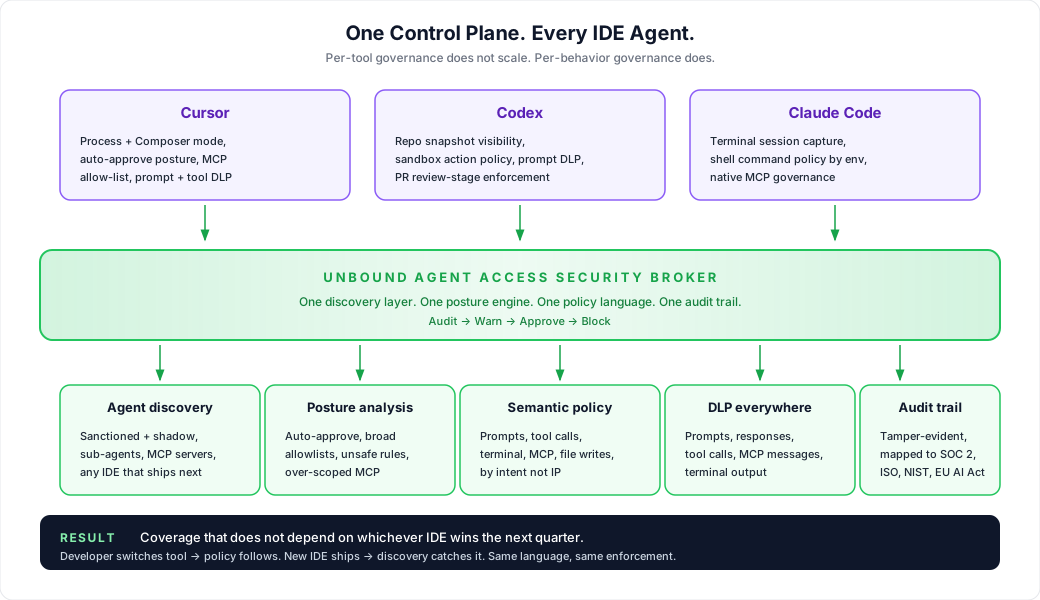
The alternative is a single policy engine that applies consistent controls across all coding agents. Discovery surfaces every agent in use. Posture analysis flags risky configurations regardless of which tool they live in. Real-time monitoring captures session activity from CLI tools, IDE-embedded agents, cloud-sandboxed agents, and any future surface that ships. Policy enforces at the action level: prompt content, MCP calls, terminal commands, file writes.
That is what an Agent Access Security Broker (AASB) does. It is the layer where Cursor, Codex, Claude Code, and whatever ships next get governed by the same rules.
How Unbound Handles the Three
- Cursor: discovery of the IDE process and Composer agent mode, posture flags on auto-approve and broad allowlists, prompt and tool-call DLP, MCP server allow-listing
- Codex: discovery of Codex usage, visibility into repository data transmitted to OpenAI's sandbox, prompt DLP, and review-stage policy enforcement on proposed code changes
- Claude Code: terminal session monitoring, shell command policy by environment, native MCP governance, direct-API DLP, full session audit trail
One control plane. One policy language. Coverage that does not depend on whichever tool wins the next quarter.
For evaluation guidance, see AASB Buyer's Guide. For background, see What is an AASB?. For MCP-specific controls, see MCP Server Governance.
Take Action
See it in your environment. Request a free risk assessment and discover every Cursor, Codex, and Claude Code instance running in your environment.
Book a demo. See one policy applied across all three at getunbound.ai/book-demo.

Co-Founder & CEO, Unbound AI
Raj is Co-Founder and CEO of Unbound AI (YC S24), building the AI Agent Security Broker (AASB) for enterprises adopting AI coding agents. Previously led DLP and CASB at Palo Alto Networks, and launched RASP and serverless security at Imperva. MIT Sloan alum. Pioneer Fund Venture Partner.
Connect on LinkedInAbout Unbound AI
Unbound AI is a YC-backed (S24) company building the AI Agent Security Broker (AASB), the governance layer enterprises use to safely deploy AI coding agents like Claude Code, Cursor, Copilot, and Codex. Unbound AI raised $4M in seed funding led by Race Capital in 2025, with participation from Y Combinator and other investors. Learn more
Ready to govern your AI coding agents?
Full visibility in under 5 minutes. No code changes. No developer workflow disruption.
Related articles
Unbound Brings Full Enforcement to GitHub Copilot

Governing Claude Across Web, Desktop, and Code: What Security Teams Need to Know
